← Back to Projects

NodeLab

Interactive simulations for ESE 2150.

Fall 2026 · In progress
  • Interactive simulation
  • ESE 2150

Key outcomes

  • The core lab shares one circuit across currents, node voltages, and the KCL equation.
  • A Wheatstone sensor, a current split, element voltage, and a nodal equation are live. Other sections are marked for a later phase.
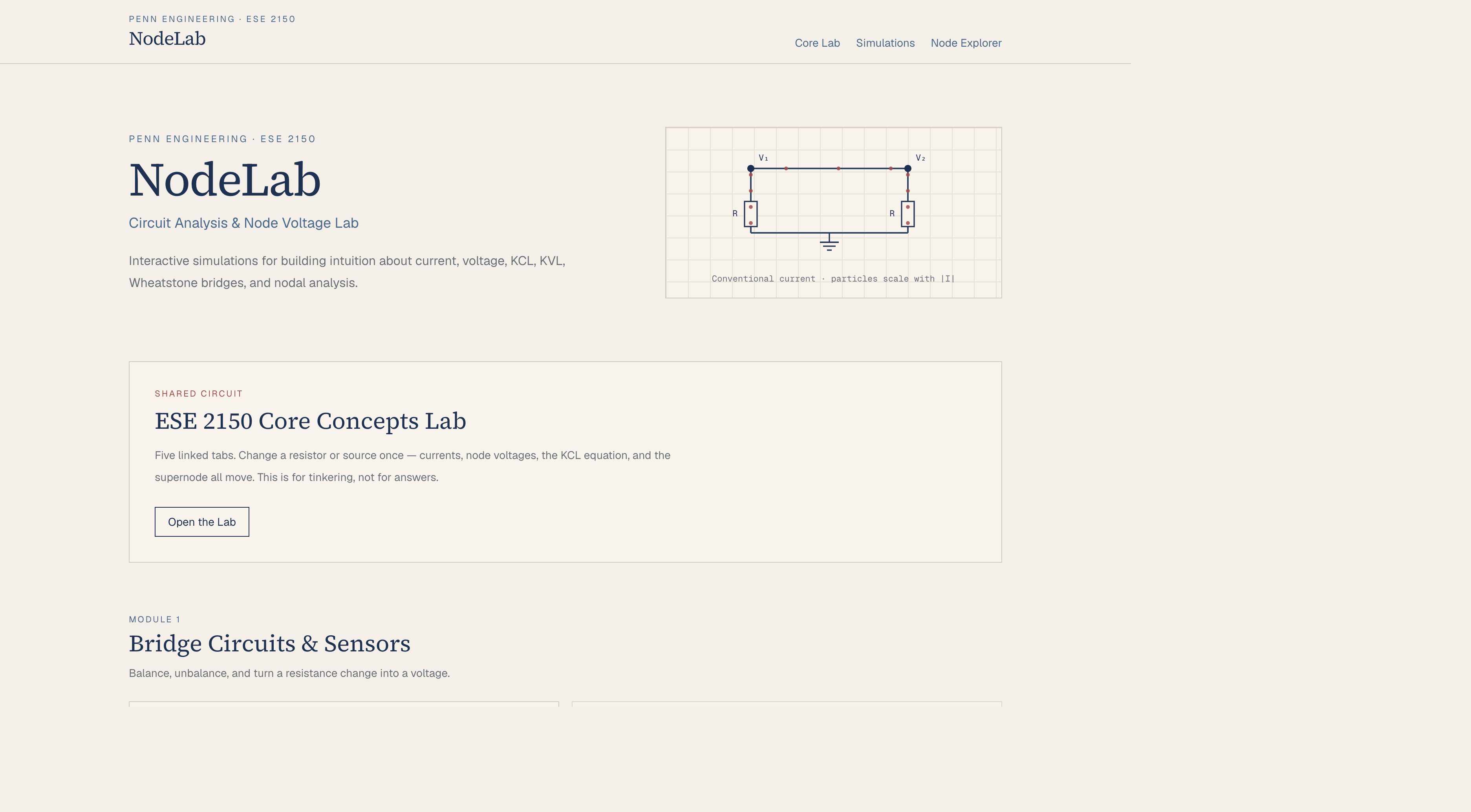
NodeLab homepage: ESE 2150 circuit lab, with a two-resistor circuit and a link to the core concepts lab
NodeLab, the ESE 2150 circuit lab. The sketch is a two-resistor loop with conventional current. The core lab opens from this page.

Project overview

NodeLab is a circuit lab for nodal analysis. I built the core lab and the simulations that are already open: a Wheatstone arm turning resistance into voltage, current splitting at one node, the voltage across an element, and a nodal equation built term by term.

Implementation

I built the core lab and the simulations that are live. The balance finder, the supernode, and several other sections are still marked for a later phase.

Full engineering log

Project notes

Highlights

What I built

  • The core lab shares one circuit across currents, node voltages, and the KCL equation.
  • A Wheatstone sensor, a current split, element voltage, and a nodal equation are live. Other sections are marked for a later phase.

Architecture

How the system works

  • One shared circuit. A resistor or source change is the input. Currents, node voltages, and the KCL equation are the output.

Challenges

What made it hard

  • Same potential is not the same current. On the live split, the node stays one voltage while the branches take different currents.
  • A Wheatstone arm turns a resistance change into a voltage. The linear sensor reading stops matching once the bridge is far from balance.

Lessons

What I learned

  • The lab is for moving one part and watching the equation, not for handing back an answer.

Stack / materials

Interactive simulationESE 2150
  • Sections still marked for a later phase include the balance finder, nodal inspection, dependent sources, and the supernode.