Lab 4
Photovoltaics and Photodetectors
I swept a silicon solar cell in the dark and under a phone flashlight, then measured a CdS photoresistor under red, green, and blue LEDs.
Objective
Find open-circuit voltage, short-circuit current, fill factor, and an efficiency estimate, then see which color moves the CdS resistance.
Takeaway
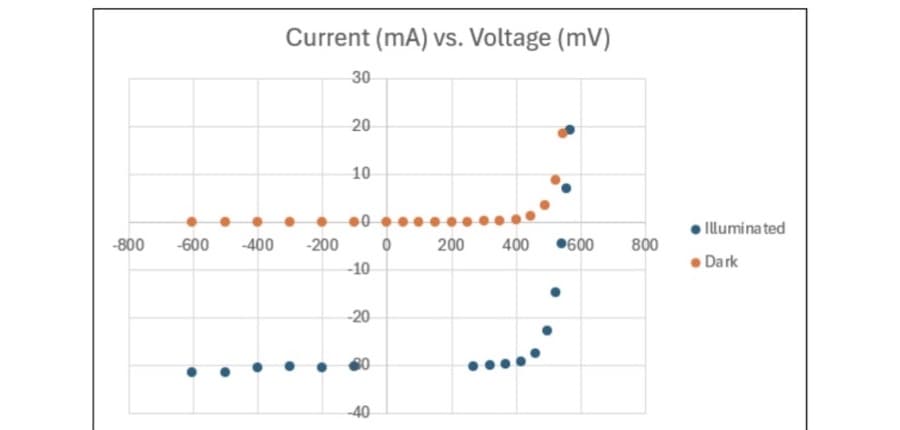
Under the flashlight the cell gave 545 mV open circuit and a fill factor of 0.79. Maximum power was 11.24 mW. Scaling the short-circuit current against the 1-sun label (0.6 V, 312 mA, 8 cm²) put the optical input near 67 mW and the efficiency near 16.7%. That is an estimate. A phone flashlight is not the solar spectrum.
Setup
Silicon cell, supply, ammeter, and voltmeter. Dark sweep in 50 mV steps until about 20 mA, then reverse from -100 mV to -600 mV. The same sweep with the phone flashlight fixed in place. CdS photoresistor from -0.5 V to 0.5 V in the dark and under red, green, and blue LEDs.
Discussion
Short-circuit current fell with the flashlight, 26.2 mA to 14.3 mA to 5.47 mA. Open-circuit voltage only moved from 545 mV to 526 mV to 495 mV. Current tracks intensity. Voltage is logarithmic in that current. Under illumination the supply would not go below 268 mV, because the cell was already making a voltage. On the CdS, dark resistance was about 4545 Ω. Blue dropped it to 3289 Ω. Red and green landed near 4050 Ω and 4080 Ω. The gap is about 2.42 eV, a cutoff near 517 nm, so blue should win. The green LED voltages did not give a clean trend: 2.8 V read lower resistance than 2.6 V and 3 V, which I treated as an outlier, not a material result. A bigger cell or a brighter lamp raises power. Neither one raises efficiency by itself.