Econometrics Labor Market Research
An empirical econometrics project analyzing how remote work and company size interact to shape salary outcomes in the global tech workforce. Pre-print publication.
IndependentEconometricsRData Analysis

PROJECT CASE STUDY
OVERVIEW
This project applies econometric methods in R to study how remote work arrangements relate to salary outcomes in the global data science and AI labor market, and whether this relationship varies by company size. Using over 130,000 observations from AI Jobs’ Data Science Salary Index, we evaluate whether remote, hybrid, and in-person roles are associated with meaningful wage differences across firms of different scales. The analysis contributes empirical evidence to ongoing debates about compensating wage differentials in the post-pandemic labor market.
WHAT I DID
- Cleaned and structured a large-scale salary dataset (132k+ observations), filtering to 2024 to 2025 to control for inflation.
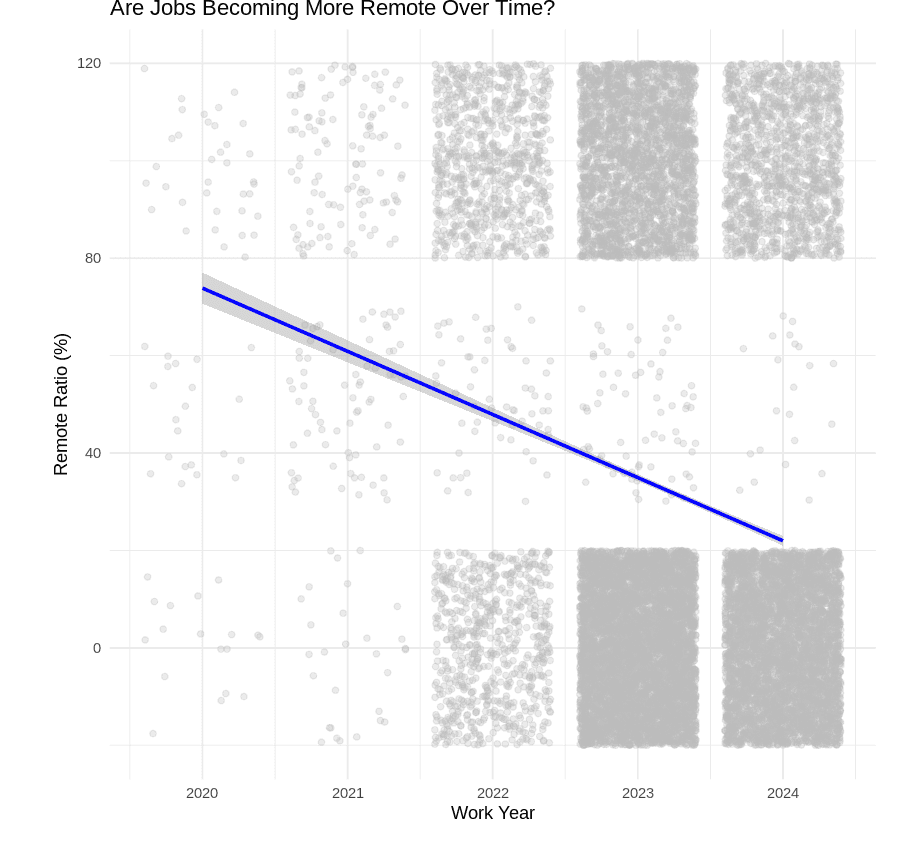
- Defined key categorical variables, including remote work ratio (in-person, hybrid, remote) and company size.
- Implemented Welch’s ANOVA in R to test salary differences while relaxing homogeneity-of-variance assumptions.
- Interpreted F-statistics, p-values, and effect sizes to separate statistical from practical significance.
- Co-authored and revised the research paper with emphasis on economic interpretation and clarity.
RESULTS / IMPACT
- Found that remote work status, company size, and their interaction are statistically significant predictors of salary.
- Challenged classical compensating wage differential models in the context of modern tech labor markets.
- Contributed to a completed academic pre-print publication.
LESSONS + NEXT STEPS
- Built practical intuition for applying econometric reasoning to labor-market data.
- Extend analysis using panel data or advanced causal inference methods.
GALLERY